When you want awareness
Use a reflective interruption before access.
Breathing, intention, emotion, and gratitude prompts create a moment to notice the urge. The best fit is the prompt you will answer honestly without rushing past it.
Category field guide · reviewed July 21, 2026
The useful question is not whether an app creates friction. It is what that friction asks you to notice—and whether it still helps after the novelty wears off.
This guide is published by GrateGuard and uses GrateGuard as one example. Linked products and platform owners are independent and do not endorse this guide.
Quick answer
A hard block is useful when access must stop. A mindful pause is useful when you want to notice an automatic choice. Timers, breathing prompts, intention checks, and gratitude rituals solve overlapping but different problems.
When you want awareness
Breathing, intention, emotion, and gratitude prompts create a moment to notice the urge. The best fit is the prompt you will answer honestly without rushing past it.
When access must stop
If opening the app is not acceptable during study, sleep, or a protected commitment, a strict rule may fit better than a reflective prompt. Some tools offer both modes.
Friction map
Evaluate the action in the middle of the loop: cue, friction, choice. That middle action is what you will repeat every day.
| Friction type | What it is good at | What to inspect |
|---|---|---|
| Breathing prompt | Creates a short physiological pause before access and can make an automatic open feel visible again. | Check whether the prompt can be skipped instantly, how long it lasts, and whether one free target is enough. one sec interruption examples |
| Intention check | Asks why you are opening an app or whether the action matches what you meant to do. | Look for a prompt short enough to answer but specific enough to change the decision. one sec intention and emotion prompts |
| Gratitude ritual | Redirects attention toward three concrete positives before a temporary access session begins. | Check where entries live, whether real private text is ever shared, and whether the ritual protects all intended apps. |
| Timer or open limit | Turns an open-ended session into a visible boundary and works well for planned breaks. | Inspect override behavior, schedule flexibility, and whether the limit resets in a way that matches your day. Opal official timer and rule overview |
| Hard block | Removes the choice during a protected window and is appropriate when access itself breaks the commitment. | Check emergency access, platform restrictions, paid-plan boundaries, and whether the product overstates tamper resistance. one sec blocking description |
Method and sources
We grouped documented app-blocking methods by the action they place between impulse and access. Examples link to first-party product and platform information. No clinical outcome or universal reduction claim is assigned to the category. Last reviewed on .
Questions
It adds a reflective step before or during access instead of relying only on a hard denial. Examples include breathing, intention checks, emotion prompts, gratitude rituals, timers, and planned sessions.
They solve different problems. A mindful prompt supports awareness and deliberate choice. A hard block is a better fit when access must stop during a protected commitment.
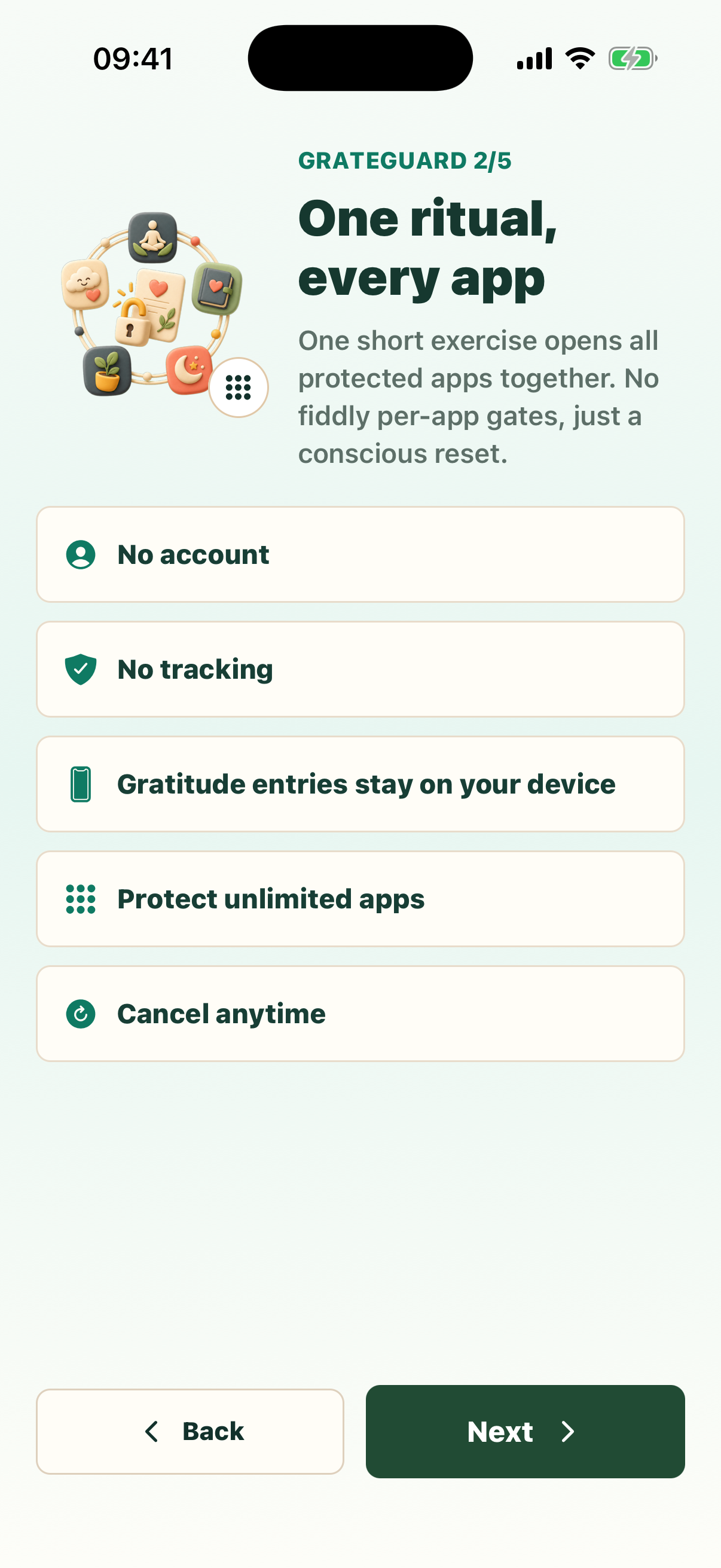
GrateGuard places a three-entry gratitude ritual before selected apps. Completing the ritual starts a temporary shared access session rather than permanently denying access.
Compare the intervention, skip and override behavior, target limits, schedules, platform support, data handling, emergency access, and which features require payment.
Try one kind of friction
Check GrateGuard’s current listing for your device, then decide whether a gratitude-specific pause matches the habit you want to build.